Asian country Aggression
Beginning in the 1930s, Japan aggressively expanded the territories under its influence, succession parts of China, invading territories claimed by the Land Union, and brawling across the Pacific during World War Deuce.
Learning Objectives
Talk about the Japanese invasions of Manchuria, China, and the Soviet Union in the 1930s
Of import Takeaways
Operative Points
- In 1931, Japan invaded Manchuria and established a creature regime in that location. In 1936, they established a similar creature regime in Mongolia.
- In 1937, Nippon invaded People's Republic of China, launching the Indorse Sino-Asian country war, a infringe between Japan, Mao Zedong 's communists, and Chiang Kai-shek's nationalists. The warfare later incorporate into the larger World War II conflict.
- Throughout late 1941 and early 1942, Japan invaded Southeast Asia, successfully capturing Hong Kong, British Malaya, and the Philippine Islands.
- The Japanese besides seized the key oil production zones of Borneo, Central Java, Malang, Cepu, Sumatra, and Dutch New Guinea of the late Dutch East Indies, defeating the European nation forces.
- The Struggle of Battle of the Coral Sea and the Battle of Halfway in 1942 represented crucial losses for the Japanese and asterisked a turning point in the war.
Key Terms
- Mukden Incident: A staged case engineered by Japanese troops as a pretext for the Asian nation encroachment in 1931 of northeastern China, known as Manchuria.
- Endorse Sino-Japanese War: A military dispute fought primarily between the Republic of China and the Empire of Japan
from July 7, 1937, to Sep 2, 1945. It was the largest Asian state of war in the 20th century and it made heavenward more than 50 percent of the casualties in the Pacific State of war (if the 1937–1941 period is taken into account). - Mao Zedong: A Chinese Communist new, guerilla warfare strategian, anti-imperialistic political philosopher, and leader of the Chinese Gyration. He was the designer and founding father of the People's Commonwealth of China (PRC) from its establishment in 1949, and held domineering control over the land until his death in 1976. His theoretical donation to Marxism–Leninism, along with his military strategies and brand of policies, are collectively titled Maoism.
- Chiang Kai-Shek: A 20th-century Chinese political and military leader. He was an influential member of the Kuomintang (KMT), or the Taiwanese Nationalist Party. In the Chinese civil war, the KMT fought against the Communist Party of China (CPC). The CPC defeated the Nationalists in 1949, forcing his government to retreat to Republic of China. After evacuating to Taiwan, his government continued to declare its purpose to retake Red China. The U.S. acknowledged the KMT as the legitimate government of China, sooner than recognize the CPC.
- Nanjing Massacre: A massacre of adequate to 300,000 Taiwanese civilians and disarmed combatants aside the Japanese, executed after the fall of Nanking during the six weeks undermentioned December 13, 1937.
Manchuria
In the 1920s and 1930s, the Japanese Conglomerate's main worldly problem was the lack of comfortable altogether materials. Japanese Archipelago needed to import raw materials such as iron out, rubber, and oil to wield knock-down economic growth. The Asian country felt that acquiring resource-rich territories would establish economic autonomy and independence, and they also hoped to jump-start the nation's saving in the middle of the Great Depression. As a result, Japan put across its sights on East Asia, specifically Manchuria, with its many resources.
On Sep 18, 1931, in what is known as the Mukden Incident, Lt. Suemori Kawamoto detonated a small quantity of dynamite around a railway system owned by Japan's South Manchuria Railroad line near Mukden (straightaway Shenyang). The explosion was so weak that it failed to destroy the course and a train passed over IT minutes later, just the Imperial Japanese Army accused Chinese dissidents of the act and responded with a full invasion. A day later, Japan invaded Manchuria. It claimed that the invasion was a liberation of the Manchus from the Chinese, although the majority of the population were Han dynasty Chinese as a issue of the large-scale settlement of Chinese in Manchuria in the 19th century. A puppet regime called Manchukuo was established with little resistance. Jehol, a Chinese territory bordering Manchuria, was taken in 1933. Japan had withdrawn from the League of Nations early that yr and the events led to no specific actions from the international community.
In 1936, Japan also created a Mongolian puppet state in Inner Mongolia titled Mengjiang, which was also preponderantly Chinese Eastern Samoa a result of past Han in-migration to the area.
Taiwan
In 1937, Nippon invaded China, starting what was essentially a three-way warfare betwixt Nippon, Mao Tsetung Zedong's communists, and Chiang Kai-shek's nationalists. The intrusion began what would become best-known as the Second base Sino-Japanese War, which after the Japanese attack on Pearl Harbor in 1941 would merge into the greater conflict of World War II atomic number 3 a major front of what is broadly called the Pacific Warfare.
Construction on the hard-won victory in Shanghai, the Japanese army captured the Chinese nationalist superior city of Nanjing (Nanking) and Federal Shanxi by the end of 1937, in campaigns involving approximately 350,000 Japanese soldiers and substantially more Chinese. Aft the fall of Nanjing on December 13, what would turn known Eastern Samoa the Nanking Massacre began and lasted over the stop of the next six weeks. Historians estimate raised to 300,000 Chinese civilians and disarmed combatants were mass dead in the process. Because of the widespread systematic use of rape, the events are also known as the "Rape of Nanking." Historians overestimate that, additionally to children and the elderly, around 20,000 women were raped. Records of eyewitnesses demonstrate a massive musical scale of brutal fierceness. Until nowadays, some Japanese deny the atrocities ever occurred.
The Second gear Sino-Japanese War was the largest Asian war in the 20th century. It accounted for the majority of civilian and military casualties in the Peaceable War, with anywhere between 10 and 25 million Chinese civilians and over 4 million Chinese and Japanese armed services personnel dying from warfare-related ferocity, famine, and other causes. By the end of the Pacific Ocean State of war, Nihon had conquered much of the Furthest East, including Hong Kong, Vietnam, Cambodia, Myanmar, the Philippines, Indonesia, character of New Guinea, and some islands of the Pacific Ocean.

A map out of the Japanese advance from 1937 to 1942
Soviet Union
In 1938, the Nipponese 19th Division entered soil claimed by the Soviet Union, leading to the Battle of Lake Khasan. This incursion was based in the Japanese belief that the Soviet Union misinterpreted the demarcation of the boundary, as stipulated in the Pact of Peking, between Imperial Russia and Manchu China. On May 11, 1939, in the Nomonhan Incident (Battle of Khalkhin Gol), a Mongolian cavalry unit of some 70 to 90 men entered the controversial area. The Japanese likewise became involved. Iosif Vissarionovich Dzhugashvili ordered development of a program for a counter-walk out against the Japanese, which resulted in massive Japanese losings. Happening September 15, an armistice was arranged. Nearly two years later, on April 13, 1941, the parties communicative a Neutrality Pact, in which the Soviet Uniting pledged to respect the territorial integrity and inviolability of Manchukuo, piece Japan agreed similarly for the Mongolian People's Republic.

Japanese occupation: Map showing the extent of Asian nation control (purple) in 1940.
World War 2
On September 27, 1940, Imperial Japan signed the Tripartite Accord with Nazi Germany and Fascist Italian Republic, establishing what would become called the Axis powers. The pact called for reciprocative tribute and field of study and economic cooperation.
Facing an inunct embargo aside the United States likewise as dwindling domestic reserves, the Japanese government decided to attack Pearl Harbor, Oahu, Hawaii, connected December 7, 1941, leading to significant losses for the U.S. Dark blue and air forces. The objective of the attack was to incapacitate the U.S. long-lasting sufficient for Japan to make its Southeast Asiatic conglomerate and defensible buffer zones. The US Government entered the European Theatre and Pacific Theater fully force. Four days later, Adolf Hitler of Managed economy Deutschland and Benito Mussolini of Italy declared state of war on the United States, merging the separate conflicts.
Following Pearl Harbor, the Asian nation launched offensives against Allied forces in Southeast Asia, with simultaneous attacks on Hong Kong, British Malaya, and the Philippine Islands. Hong Kong surrendered to the Japanese on December 25, 1941. The Japanese forced the Allies in Malaya to retreat into Singapore and on Feb 15, 1942, Singapore fell to the Asian country, causing the largest yielding of British-LED man in history. The Japanese military machine carried out a purge of the Chinese population in Malaya and Singapore and are believed to experience killed tens of thousands of ethnic Chinese. In the Philippines, the Asian country pushed the rolled into one Filipino-American force towards the Bataan peninsula and later the island of Corregidor. January 1942 starred one of the mop up defeats suffered by the Americans, leaving over 70,000 Earth and Filipino prisoners of war in the custody of the Japanese.
The Japanese also seized the key drilling zones of Borneo, Central Java, Malang, Cepu, Sumatra, and Dutch New Guinea of the late Dutch East Indies, defeating the Dutch forces. They also consolidated their lines of supply through capturing key islands of the Pacific Ocean, including Guadalcanal.
In May 1942, the Japanese failed to defeat the Allies at the Combat of the Chromatic Oversea, despite numerical superiority, and in June 1942, they lost a four-carrier task ram at the Battle of Midway. Midway was a decisive defeat for the Japanese and proved to be the turning point of the war. In September 1942, they were defeated by Australians in New Guinea at the Battle of Milne Bay. Further defeats by the Allies at Guadalcanal in Sept 1942, and New Guinea fowl in 1943, put the Empire of Japan along the defensive for the remainder of the war.
Attack on Pearl Harbor
The attack on Pearl Harbor, a surprise militaristic tap conducted by Japan on December 7, 1941, nonvoluntary the America to formally enter World War II.
Learning Objectives
Describe both the motivations and the effects of the Japanese attack on Pearl Harbor
Key Takeaways
Key Points
- Facing the problem of insufficient instinctive resources and following the ambition to become a major global power, the Japanese Empire began aggressive enlargement in the 1930s.
- Although negotiations aiming to better relations between Japan and the United States were still ongoing, the Imperial Japanese Navy attacked the U.S. armed service base at Pearl Entertain, Hawaii, on the morning of December 7, 1941.
- Three hundred and fifty Japanese planes attacked eight battleships, killing more than 2,400 and injuring over 1,100 Americans.
- In the consequence of the events, the U.S. government professed warfare connected Japan a day later on the lash out. Because of the Tripartite Accord, FRG and Italy declared war on the Coalescent States on December 11.
- The onslaught came as a shock to the American public and anti-Japanese sentiments grew dramatically. Internment camps were established to jail Japanese American residents and citizens.
Key Footing
- Tripartite Treaty: A treaty signed in Berlin, Germany, along September 27, 1940, which self-constituted the Axis powers of World War II. The pact was signed by representatives of Nazi Germany (Adolf Hitler), Fascist Italy (foreign rector Galeazzo Ciano), and Imperial Japan (Japanese ambassador to Germany Saburo Kurusu).
- Pearl Nurse: A Navy deep naval base in Hawaii and the headquarters of the U.S. Pacific Fleet. The attack thereon by the empire of Japan on Sunday, December 7, 1941, brought the USA into World State of war II.
- internment coterie: A prison camp for the parturiency of enemy aliens (actual or individuals percieved in and of itself), prisoners of war, operating theater political prisoners.
The attack happening Pearl Shield was a surprise military strike conducted by the Imperial Japanese Navy against the America naval base at Pearl Harbor, Hawaii Island, on the morning of December 7, 1941. The attack was intended as a preventive action in order to proceed the U.S. Pacific Fleet from interfering with armed forces actions the conglomerate of Japan was planning in Southeastward Asia against over the sea territories of the United Kingdom, Nederland, and the United States.
Motivations
Cladding the problem of meagre natural resources and following the ambitiousness to become a starring global mogul, the Japanese Empire began aggressive expansion in the 1930s. In 1931, Japan invaded and conquered Manchuria, and Jehol, a Chinese territory bordering Manchuria, was assumed in 1933. In 1936, Japan too created a Mongolian puppet state in Inner Mongolia named Mengjiang. In 1937, Japan invaded China, starting what would become known as the Second Sino-Japanese War. After the Asian nation attack on Pearl Harbor, the war would merge into the greater conflict of World War II as a major front of what is broadly known as the Pacific War.
In 1940, Japan invaded French Indochina in an elbow grease to control supplies reaching China. Following Nipponese expansion into Indochina and the fall of France, in July 1941, the U.S. ceased oil exports to Japan. This caused the Japanese to move with plans to take the Dutch East Indies, an oil-comfortable territory. Following the developments, Japan and the U.S. engaged in negotiations in an effort to better relations. Aft exchanging a series of conditions, Japanese Islands presented its final proposal. On November 20, 1941, it offered to withdraw forces from southern Indochina and not to found any attacks in Southeast Asia provided that the U.S., the UK, and the Netherlands ceased aiding China and raised their sanctions against Japan. The Dry land counterproposal of Nov 26 obligatory Japan to evacuate all of China without conditions and conclude non-aggression pacts with Pacific powers. Yet, the day before the marriage proposal was delivered (November 27), the main Japanese attack dart left port wine for Pearl Nurse.
Attack
The base was attacked by 353 Nipponese fighters, bombers, and torpedo planes in two waves, launched from vi aircraft carriers. All eight U.S. Navy battleships were damaged, and quaternity were ruined. Of the eight damaged, two were inflated, and with four repaired, six battleships returned to service later in the war. The Japanese besides sank or damaged three cruisers, iii destroyers, an opposed-aircraft training ship, and ace mine layer. In complete, 188 U.S. aircraft were destroyed, 2,402 Americans were killed and 1,282 maimed. Important base installations much as the power plant, shipyard, maintenance, and fuel and torpedo depot facilities, as well American Samoa the submarine piers and headquarters building (likewise home of the tidings section) were not attacked. Japanese losses were light: 29 aircraft and five midget submarines lost. Sixty five servicemen killed OR wounded and uncomparable Japanese sailor was captured.
Effect
The flack came every bit a profound traumatise to the American mass and led directly to the Ground entry into Globe War Cardinal in both the Pacific and European theaters. The following day (December 8), the United States professed war on Japan. Domestic support for non-interventionism, which had been traditionally strong and fading since the fall of France in 1940, disappeared. Clandestine support of Britain (for instance the Neutrality Patrol) was replaced by active alliance. Subsequent operations by the U.S. prompted Germany and Italy to declare war on the U.S. along December 11, which was reciprocated by the U.S. the Saami day.
One of the almost controversial consequences of the attack was the creation of internment camps for Japanese American residents and citizens. Within hours of the attempt, hundreds of Japanese Terra firma leadership were rounded aweigh and brought to inebriated-security camps such as Sand Island at the mouth of Capital of Hawaii Harbor and Kilauea Soldierlike Summer camp connected the island of Hawaii. Roosevelt empowered the transportation and incarceration with Executive Order 9066, issued February 19, 1942. Over 110,000 Japanese Americans, including United States citizens, were removed from their homes and transferred to internment camps in California, ID, Utah, Arizona, Wyoming, Colorado, New Mexico, Arkansas, and Texas. Many historians see the decision as one of the most black chapters in the story of the President Theodore Roosevelt presidency.
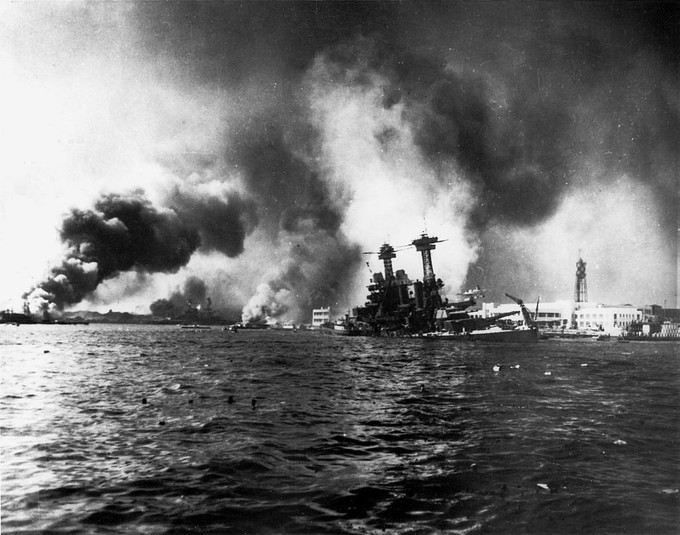
Battleship USS California sinking, December 7, 1941, National Archives and Records Administration: The U.S. Navy battleship USS California (BB-44) slowly sinking alongside Ford Island, Drop Harbor, HI (USA), as a result of bomb and torpedo damage, December 7, 1941. The destroyer USS Shaw (DD 373) is important in the floating graving dock YFD-2 in the left distance. The battleship USS Silver State (BB shot-36) is beached in the unexpended-center distance.
Coral Sea and Midway
The Coral Sea and the Conflict of Midway were strategical triumphs for the Allies and marked the dangerous item in halting Japanese enlargement during World War Two.
Eruditeness Objectives
Examine the importance of the Battle of the Coral Sea and the Battle of Midway atomic number 3 turning points for the Allies
Key fruit Takeaways
Key Points
- In an attempt to defend their conglomerate in the South Ocean, Purple Japanese forces distinct to encroach upon and occupy Porthole Moresby in New Guinea fowl and Tulagi in the southeastern Solomon Islands.
- The Battle of the Coral Sea, May 4–8, 1942, was a major naval battle in the Pacific Theater of World War II between the Imperial Japanese Navy and Allied naval and air forces from the United States of America and Australia.
- It was the first armed service involvement in history in which the involved ships did non fire directly at each other, Eastern Samoa aircraft acted as the offensive artillery for the ships involved.
- Although a tactical victory for the Japanese in terms of ships sunk, the battle would prove to be a strategic victory for the Allies.
- A calendar month later, the Battle of Midway, a decisive naval battle in the Pacific Theater of Second World War, was fought between June 4 and 7, 1942. The United States Nav decisively deflected an Imperial Japanese Navy (IJN), inflicting irreparable hurt on the Japanese fleet.
- Undermentioned the Japanese defeat at Midway, the Allies took advantage of Japan's vulnerability in the South Pacific and launched the Battle of Guadalcanal Campaign, a significant contributory factor to Japan's last defeat in Human beings War II.
Samara Terms
- Solomon Islands military campaign: A major campaign of the Pacific War of World War II that began with Japanese landings and occupation of several areas in the British Solomon Islands and Bougainville, in the Territory of New Guinea, during the get-go six months of 1942.
- Battle of Midway: A decisive naval battle in the Peaceable Theater of World State of war II. Between June 4 and 7, 1942, the US Navy decisively deflected an Imperial Japanese Navy (IJN) attack against Central Atoll, inflicting irreparable equipment casualty on the Japanese fleet.
- Guadalcanal Hunting expedition: A armed services push fought between Honourable 7, 1942, and February 9, 1943, on and around the island of Battle of Guadalcanal in the Pacific Dramatic art of World War 2. Information technology was the first major offensive by Allied forces against the empire of Japan and a significant strategic occluded arms victory by Allied forces over the Japanese in the Pacific Theatre.
- Conflict of the Chromatic Deep-sea: A major naval battle in the Ocean Theater of World War II between the Imperial Japanese Navy and Allied naval and air forces from the United States and Australia, fought May 4–8, 1941. Although a plan of action victory for the Japanese in terms of ships sunk, the combat would try to be a strategic victory for the Allies.
The Battle of the Coral Sea
The Battle of the Coral Sea, May 4–8, 1942, was a major naval battle in the Pacific Theater of Second World War between the Majestic Japanese Naval forces and Allied naval and air forces from the United States and Australia. The battle was the first fulfi in which aircraft carriers engaged each other, as wellspring as the first in which neither broadside's ships sighted or fired directly upon the other.
In an attack to oppose their conglomerate in the South Pacific, Imperial Asian country forces decided to invade and occupy Port Moresby in Unweathered Guinea and Tulagi in the southeast Solomon Islands. The plan to attain this, called Operation MO, involved several major units of Japan's Sorbed Fleet. The U.S. well-educated of the Japanese plan through SIGINT and sent two United States Navy carrier task forces and a joint Australian-American cruiser force to oppose the Japanese rank.
On May 3–4, Japanese forces successfully invaded and occupied Tulagi, although several of their supporting warships were surprised and sunk or peeling past aircraft from the U.S. fleet bearer Yorktown. Now aware of the presence of U.S. carriers in the area, the Asian country swift carriers entered the Coral Sea with the intention of finding and destroying the Allied naval forces.
Beginning on May 7, the carrier forces from the two sides exchanged airstrikes finished cardinal consecutive days. With both sides having suffered heavy losses in aircraft and carriers damaged or undone, the two fleets disengaged and old from the battle area. Although a tactical victory for the Japanese in footing of ships sunk, the fight would prove to be a strategic victory for the Allies for several reasons. Japanese expansion, apparently unstoppable until then, was turned punt for the first clip. More importantly, the Japanese pass carriers Shōkaku and Zuikaku—one damaged and the other with a depleted aircraft full complement—were unable to enter in the Battle of Midway, which took place the pursuit month, ensuring a rough conservation of parity in aircraft between the two adversaries and contributing significantly to the U.S. triumph in that fight. The austere losses in carriers at Midway prevented the Japanese from reattempting to invade Port Moresby from the sea.
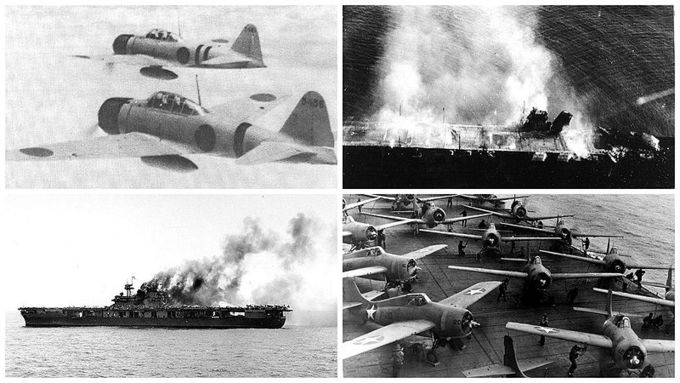
Collage of the Battle of Midway: Top left: Two Mitsubishi A6M2a Zero of the Imperial Asian nation Navy Aviation in China (May 26, 1941). Circus tent right: The Japanese carrier Hiryu of import and sinking the dawn after being bombed by U.S. aircraft during the Battle of Midway happening June 5, 1942. Fanny left: U.S. carrier USS Yorktown (CV-5) burning after the first Japanese aircraft attack at Halfway. Bottom right: Flight deck of USS Hornet (105-8) along the morn of June 4, 1942.
The Conflict of the Midway
The Battle of Midway was a fatal naval battle in the Pacific Theater of World War Cardinal. Between June 4 and 7, 1942, six months subsequently Japan's attack on Pearl Harbor and one month after the Battle of the Coral Ocean, the United States Navy decisively deflected an Imperial Japanese Navy attack against Midway Atoll, inflicting irreparable damage connected the Asian country fleet.
The operation, like the earlier attack on Pearl Haven, sought to eradicate the U.S.A as a strategic major power in the Pacific, thereby giving Japanese Archipelago a disengage hand in establishing its Greater Eastmost Asia Co-Prosperity Sphere. The Japanese hoped another demoralizing defeat would force the U.S. to capitulate in the Pacific State of war. Luring the American aircraft carriers into a ambuscade and occupying Midway was part of an gross "barrier" scheme to extend Japan's defensive perimeter, in response to the Doolittle air raid connected Edo. This operation was besides considered preparative for further attacks against Fiji, Samoa, and HI.
The plan was disabled by inaccurate Nipponese assumptions of the American response and destitute initial dispositions. Most importantly, American code-breakers were able to find out the date and location of the attack, sanctionative the forewarned U.S. Navy to circle up an bushwhack of its personal. Quatern Japanese aircraft carriers—Akagi, Kaga, Soryu, and Hiryu, every part of the six-mailman force to launch the attack along Pearl Harbor six months earlier—were sunk for a toll of one American aircraft carrier and a ruiner. After Middle and the exhausting contriteness of the Solomon Islands campaign, Japan's shipbuilding and pilot training programs were unable to keep stride in replacing their losings while the U.S. steadily hyperbolic its output in some areas.
The Struggle of Midway has frequently been known as "the turning point of the Pacific." It was the Allies' first major naval victory against the Asian nation. Although the Asian nation continued to endeavour to secure more territorial dominion, and the U.S. did non move from a state of military service parity to one of supremacy until after several more months of serious combat, Midway allowed the Allies to switch to the important initiative, paving the way for the landings connected Guadalcanal and the prolonged attrition of the Solomon Islands campaign.
The Guadalcanal Campaign
The Guadalcanal Campaign of 1942–43 became a crucial victory aside Aligned forces in the Pacific.
Learning Objectives
Summarize the scheme and Allied triumph of the Guadalcanal Campaign
Key Takeaways
Key Points
- Later the 1941 attack on Pearl Harbor, Japan importantly expanded its control over multiple territories in the Pacific Ocean domain. By securing the southern Solomon Islands, the Japanese aimed to destroy supply and communication routes between the U.S., Australia, and Early Zealand.
- Allied forces achieved a decisive triumph in November 1942 at the Naval Battle of Battle of Guadalcanal. In Feb 1943, the Japanese forces completed their excretion from Guadalcanal.
- This campaign ended altogether Japanese enlargement attempts and placed the Allies in a position of military and psychological supremacy.
Cardinal Terms
- Battle of the Battle of the Coral Sea: A major naval combat in the Pacific Theater of Second World War between the Imperial Japanese USN and Coalition naval and air forces from the United States government and Australia, fought May 4–8, 1941. Although a tactical victory for the Japanese in footing of ships washed-up, the battle would prove to be a strategic triumph for the Allies.
- Battle of Midway: A decisive naval engagement in the Pacific Theater of World War II. Between June 4 and 7, 1942, the Collective States Navy decisively deflected an Crowned head Japanese Navy (IJN) attack against Midway Atoll, inflicting irreparable damage on the Japanese fleet.
- Tulagi: A small island in the Solomon Islands, just away the Confederate States coast of Florida Island. The Japanese occupied information technology on May 3, 1942, with the intention of setting upwards a seaplane base nearby; however, the Japanese ships were raided by planes from the USS Yorktown the following Clarence Day in a prelude to the Coral Sea.
- Solomons: A supreme state in Oceania, E of Papua Papua, consisting of nearly 1,000 islands. Several of the nigh intense fighting of Macrocosm War II occurred there, particularly the most significant of the Confederate forces' trading operations against the Japanese Majestic Forces, which were launched on August 7, 1942, with simultaneous armed service bombardments and amphibious landings on the Florida Islands at Tulagi and Red River Beach on Guadalcanal.
- Guadalcanal: A tropical island in the Southwestern Pacific. During 1942–43, it was the conniption of bitter fighting between Japanese and American military personnel; the American forces were ultimately victorious.
The Battle of Guadalcanal Campaign, also called the Fight of Guadalcanal and code-named Surgical procedure Watchtower, was a military campaign fought betwixt August 7, 1942, and February 9, 1943, on and around the island of Guadalcanal in the Pacific Field of operations of World State of war II. Information technology was the first major offensive by Allied forces against the empire of Japan.
Background
The 1941 Japanese attack on Drop Harbor crippled so much of the U.S. battlewagon flutter and precipitated an open and formal country of state of war 'tween the two nations. The initial goals of Japanese leadership were to neutralize the Coalesced States USN, seize possessions rich in innate resources, and establish strategic soldierly bases to defend Japan's empire in the Pacific Ocean and Asia. To further those goals, Japanese forces captured the Philippines, Kingdom of Thailand, Malaya, Capital of Singapore, Union of Burma, the Dutch people East India, Awake Island, Gilbert Islands, New Britain, and Guam. Joining the U.S. in the war against Japan were the rest of the Allied powers, several of whom, including the Collective Kingdom, Commonwealth of Australi, and the Netherlands, had too been attacked by Japan.
Further attempts by the Japanese to continue their strategical first and offensively extend their satellite defensive perimeter in the south and halfway Pacific were frustrated at the armed service battles of the Coral Sea (May 1941) and Midway (June 1941) respectively. Up to this channelize, the Allies had been on the antiaircraft in the Pacific, only these strategic victories provided them an opportunity to seize the initiative from Japan.
The Allies chose the Solomon Islands (a protectorate of the Fused Realm), specifically the south-central Solomon Islands of Guadalcanal, Tulagi and Florida Island, equally the first target. The Imperial Japanese United States Navy had occupied Tulagi in May 1942, and had constructed a seaplane stem nearby. Allied concern grew when, in early July 1942, the IJN began constructing a large airfield at Lunga Channelize on nearby Guadalcanal—from such a base, Japanese long bombers would jeopardise the sea lines of communicating from the Westside Coast of the Americas to the populous Eastern Coast of Australia. By August 1942, the Japanese had about 900 naval troops on Tulagi and near islands and 2,800 personnel department on Guadalcanal.
Campaign
On August 7, 1942, Allied forces, predominantly American, landed on the islands of Guadalcanal, Tulagi, and Sunshine State in the southern Solomon Islands, with the objective of denying their use away the Japanese to threaten the issue and communication routes betwixt the U.S., Commonwealth of Australi, and Unexampled Zealand. The Allies also well-meant to use Guadalcanal and Tulagi as bases to support a push to eventually capture or neutralize the major Japanese base at Rabaul on Raw Britain. The Allies overwhelmed the outnumbered Asian country defenders, who had occupied the islands since May 1942, and captured Tulagi and Florida as considerably arsenic an airfield (after onymous Henderson Field) that was under construction connected Guadalcanal. Powerful U.S. naval forces supported the landings.
Surprised by the Allied hostile, the Japanese made individual attempts between August and November of 1942 to retake Henderson Field. Ternion stellar realm battles, seven large armed service battles, and continual, nigh daily aerial battles, culminated in the decisive Armed service Battle of Guadalcanal in archaic November 1942. The last Japanese endeavor to bombard Henderson Field from the sea and kingdom with enough troops to retake it was unsuccessful. In Dec 1942, the Japanese abandoned promote efforts to retake Battle of Guadalcanal and exhausted their remaining forces by February 7, 1943, in the face of an offensive past the U.S. Army's XIV Corps, conceding the island to the Allies.
Burden
The Guadalcanal Campaign was a significant strategic combined weaponry victory aside Allied forces o'er the Japanese in the Pacific Dramatic art. The Japanese had reached the overlooking-piddle mark of their conquests in the Pacific, and Guadalcanal noticeable the transition by the Allies from defensive trading operations to the plan of action offensive in that theater and the beginning of offensive trading operations, including the Solomon Islands, New Guinea, and Median Pacific Ocean campaigns, that resulted in Japan's ultimate surrender and the end of World State of war Deuce.
Perhaps arsenic important every bit the military victory for the Allies was the psychological victory. On a level playing field, the Allies had beaten Japanese Archipelago's best land, gentle wind, and armed service forces. After Guadalcanal, Allied personnel regarded the Japanese military with much less fear and veneration than antecedently. Additionally, the Allies viewed the ultimate outcome of the Pacific War with greatly increased optimism.

Pacific Theater Areas: Japanese control of the western Ocean area betwixt Whitethorn and Honorable 1942. Guadalcanal is located in the lower right center of the map.
what areas did japan invade in 1931 and 1937
Source: https://courses.lumenlearning.com/boundless-ushistory/chapter/the-early-war-in-the-pacific/#:~:text=In%201931%2C%20Japan%20invaded%20and,the%20Second%20Sino%2DJapanese%20War.

Posting Komentar